
*DISCLAMER*
Navigating tree law is complex, and minor details may significantly influence legal outcomes and cases. We are not attorneys, and this is not intended as legal advice. For legal advice, consult an attorney. The following is generally accepted as true, but your circumstances are different and may not apply. I cannot stress enough that if you need legal advice, you need to consult with an attorney. We do offer consulting services and would be happy to provide any tree-related guidance to your attorney.
Property Rights and Tree Law
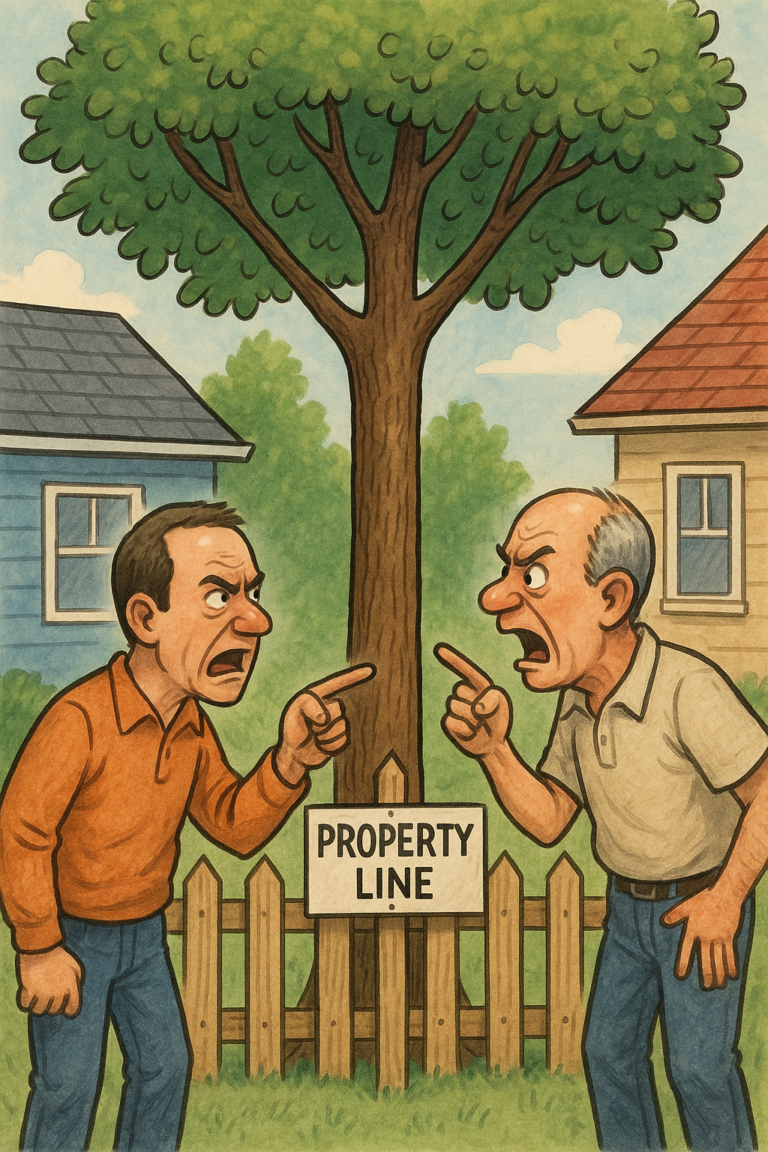
We are often asked about tree law in Kansas. Trees often encroach on neighboring properties, and homeowners are curious about their rights. When speaking about trees, there are four key rights that we should take into account.
The right to:
- Alienate – This refers to the right to sell or give the tree to another party.
- Possess – Property owners have the right to claim ownership and control over the trees on their land.
- Use – Owners have the right to use the tree as they see fit, whether for wood, fruit, or other purposes.
- Destroy – Property owners can remove or destroy trees on their land, provided that it does not infringe on the rights of other property owners or violate local ordinances.
These rights apply equally to both you and your neighbor, especially when trees grow near property lines, affecting both landowners. It’s important to recognize that property rights concerning trees extend beyond just ownership—they also define what you can and cannot do with the tree, and how it interacts with neighboring properties.
Ownership of trees
To fully understand tree law, we must first define the concept of ownership. Generally, trees are considered real property, which means they are permanently attached to the land and are owned by whoever owns the land on which the tree stands. This is a fundamental principle that frequently arises in legal disputes.
For guidance, we can examine the case of Wideman v. Faivre. The court in this case explained that, “Generally, a tree is the sole property of the person on whose land the trunk stands, even if its roots extend onto a neighbor’s land or branches overhang.” This means that ownership of the tree typically belongs to the property owner where the tree’s trunk is rooted. However, if a tree straddles the boundary line between two properties, each property owner has an interest in the tree’s care and use.
That being said, when there are two parties, there are two sets of rights.
Under property law, the owner of a parcel of land has the right to the airspace above it, as well as the ground beneath it. If a tree from a neighboring property grows over your land, the overhanging branches technically encroach on your airspace.
Historically, property law has allowed property owners to trim branches that extend over their land up to the property line, as this does not infringe on the neighbor’s land. This concept is tied to the right to possession—you can manage, use, and maintain anything that exists on your property, including airspace. However, you cannot trespass onto a neighbor’s property to perform the trimming; doing so would violate the neighbor’s rights.
This gets tricky because what if pruning would cause irreparable harm to your neighbors tree?
Pierce v. Casady Tree Law Case
Let’s examine a specific case from Kansas law, Pierce v. Casady. In Pierce v. Casady, the main issue was whether the landowners (Plaintiffs) had the right to trim or remove branches from a tree owned by their neighbors (Defendants), which overhung their property and posed a potential danger. The tree had a split in its trunk, leaning towards the Plaintiffs’ property, which created a risk of falling and could cause damage to their home, garage, and vehicles. The Plaintiffs petitioned the court for a declaratory judgment, seeking the right to trim the overhanging branches or, alternatively, to have the tree removed as a nuisance.
Nuisance Tree
We need to define a nuisance. A nuisance tree is generally characterized by its potential or actual harm to persons or property, its unreasonable interference with the rights of others or the public, or when it is officially declared as such by legislative or local ordinances due to conditions like disease, obstruction, or safety risks.
In Pierce v. Casady, the court found that the overhanging branches of the tree were a nuisance because they posed a significant risk to the neighboring property, including the house, garage, and cars. The tree’s condition—specifically the split in the fork—created a danger that could result in damage if the tree fell.
So, who determines a nuisance? Oftentimes, it is a court, the legislature, or municipalities. However, arborists, such as Tree Risk Assessment Qualified Arborists, can help provide critical information that will aid the court in making its decision.
What does this mean for homeowners?
Ultimately, the court stated, “The philosophy of the law is simply that whenever neighbors cannot agree, the law will protect each property owner’s rights insofar as that is possible.”
You generally have the right to prune your neighbor’s tree branches that extend onto your property, up to your property line. However, you cannot trespass onto your neighbor’s property to do the pruning. You may also run into problems if you violate any of your neighbor’s rights mentioned above. Remember, if you kill the tree with your actions, you may have violated their rights. If the tree or its branches constitute a nuisance (causing substantial harm or imminent danger), you may have legal avenues to compel your neighbor to address the issue, potentially even removal.
At Wellnitz Tree Care, we always recommend being a good person and communicating with your neighbor before pruning their tree, even if you are within your legal rights. You may avoid having to tell your story to the judge.
